Tags

Michael McCreesh
Managing Director, Head of SS&C Battea
August 7, 2026
3 min read

What happens to the money that fund managers fail to recover from securities class actions? It does not sit waiting to be claimed. It is redistributed among investors who have successfully filed, meaning those who do not file miss the opportunity to recover—and they also hand competitive firms an advantage.
We recently spoke with global hedge fund managers at the invitation-only SS&C Battea Fireside Chat: Institutional Investment Recovery From Securities Class Actions and Special Litigations in Hong Kong. While many were familiar with securities class action recoveries, far fewer understood the financial and competitive cost of not pursuing them. Every unclaimed settlement increases the share available to those who do claim, turning an obscure administrative process into another source of non-investment alpha.


The opportunity itself is substantial, with around 400 new securities class actions filed each year, and typically, less than 50% result in actionable settlements. At any one time, between $14 billion and $15 billion is reserved for distribution to investors across more than 360 settlements, creating a significant pool of potential recoveries for eligible institutions.
For investment managers, however, identifying opportunities is only part of the challenge. Recovering those funds successfully requires having expertise across multiple asset classes, understanding the machinations of increasingly complex financial instruments and navigating a claims process that has become considerably more demanding in recent years.
That is where specialist providers begin to differentiate themselves and their returns.
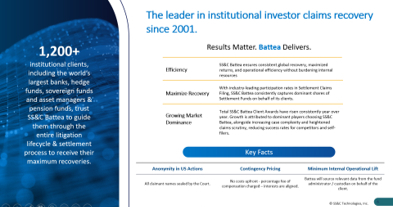
While there is no shortage of organizations that can submit claims on a client’s behalf, SS&C’s approach has more breadth and depth than most propositions. The firm's specialists verify recognized losses, work directly with claims administrators, respond to requests for additional information and resolve claim deficiencies throughout the settlement process. Much of the work takes place after the paperwork has been submitted, but it is often these behind-the-scenes activities that have the greatest influence over how much clients ultimately recover.
This expertise and the ability to understand the details of diverse and complex cases has become increasingly important as claims administrators scrutinize submissions more closely. More documentation is being requested, transaction structures have become more complex and unsuccessful claims are becoming more common. Simply filing a claim is no longer enough—managers also need to be confident that their provider has the expertise to defend the content of their submissions and maximize recoveries once the process is underway.
Despite the potentially significant upsides, the practical burden on clients is remarkably light. After authorizing access to historical transaction data, SS&C manages the process on the client's behalf, working directly with fund administrators and custodians where required. Operating on a contingency basis, the firm is only paid when recoveries are successfully made.
As with any third-party relationship, data security remains an important consideration. It is worth noting that claims rely on historical trading information rather than live portfolio data. In addition, dedicated security infrastructure and strict access controls help protect sensitive client information.
Fund managers spend considerable time and effort searching for new ways to improve returns, yet one of the simplest opportunities may already exist within their own historic trading activity.
Watch the full "SS&C Battea Fireside Chat" presentation to learn more.