Tags

Ali Sarangi
Director, Regulatory Solutions
July 23, 2026
5 min read

Clean, reliable data is only part of effective reporting. For many asset managers and financial institutions, the greater challenge lies in transforming that data into accurate, timely reports without relying on manual processes that consume valuable time and resources.
SS&C Sightline recently hosted a webinar to shed light on the operational challenges and inefficiencies in financial reporting processes within asset management and financial firms. Led by Ali Sarangi and Aneesa Rasool (Directors), and accompanied by Ryan Lum (Associate Director), the session served as a platform to identify pain points in reporting workflows and demonstrate how Sightline, SS&C’s innovative reporting analytics platform, offers scalable solutions.
Understanding the Reporting Gap
Many firms have invested heavily in improving data quality, yet an important operational gap often remains between having trusted data and delivering reports to the people who need them. Most organizations have done the hard work of actually getting their data in order. But what actually happens in between? Between the data being ready and the report landing in the right person's hand?
This framing encapsulates the core issue faced by many firms today—manual interventions, inefficiency and lack of scalability when transitioning clean, available data into actionable reports. Sarangi expanded on this by elaborating, "People are manually reconciling data, adjusting spreadsheets and calculations every single cycle. We sometimes describe it as the cycle tax, the invisible operational overhead that gets paid every reporting period.”
Such processes grow exponentially more challenging for larger firms, as operational scalability often depends on additional human resources rather than technological advancements.
"Just recently we worked with one asset manager whose quarterly reporting was consuming around eighty FTE hours per cycle…two weeks of senior analyst time every quarter on one process." – Rasool
Challenges of Customization and Scalability
Many firms that aim to offer customized reporting face an overwhelming proliferation of report variations.
“Once firms start accommodating different client preferences, the number of report variations tend to explode…you end up with dozens, if not hundreds, of slightly different outputs.” – Rasool
Each variation typically requires manual adjustments, leaving firms trapped in a cycle of complexity. This burden is compounded when firms accept that operational complexity is inevitable for customized reporting. SS&C Sightline aims to challenge this assumption, making scalable and efficient reporting achievable without sacrificing customization.
Timely Access and Reporting Bottlenecks
Timely data access for leadership often exacerbates reporting inefficiencies. Sarangi explained, "Senior stakeholders increasingly expect information immediately in a format that makes sense for them… But those requests still flow back through the reporting team, leading to delays."
Reporting stops being a strategic enabler and starts becoming a bottleneck. Senior stakeholders end up waiting for the report that takes three days to refresh or for the analysis they could have done themselves in minutes if they had access to the data.
This scenario highlights the critical need for automated processes and self-service capabilities for stakeholders, two areas where Sightline excels.
Introducing Sightline: A Modular Solution for Reporting
Sightline was designed to overcome the trade-off between customization and operational complexity. The platform enables firms to gradually phase in its technology without disrupting existing processes.
Sightline integrates seamlessly with legacy systems and provides a stepwise pathway for adoption, ensuring that firms can maintain their operations while implementing new tools. One example of this flexibility is the automated cash reconciliation workflows and report scheduling tools.
Platform Features: Streamlining Data Access and Reporting
Key features of Sightline highlighted during the session included:
- Data Integration and Automation: Sightline unifies disparate data sources—whether client-provided, SS&C-generated or third-party—into a single source of truth. Sightline is data agnostic. The flow of each data source is automated and scalable.
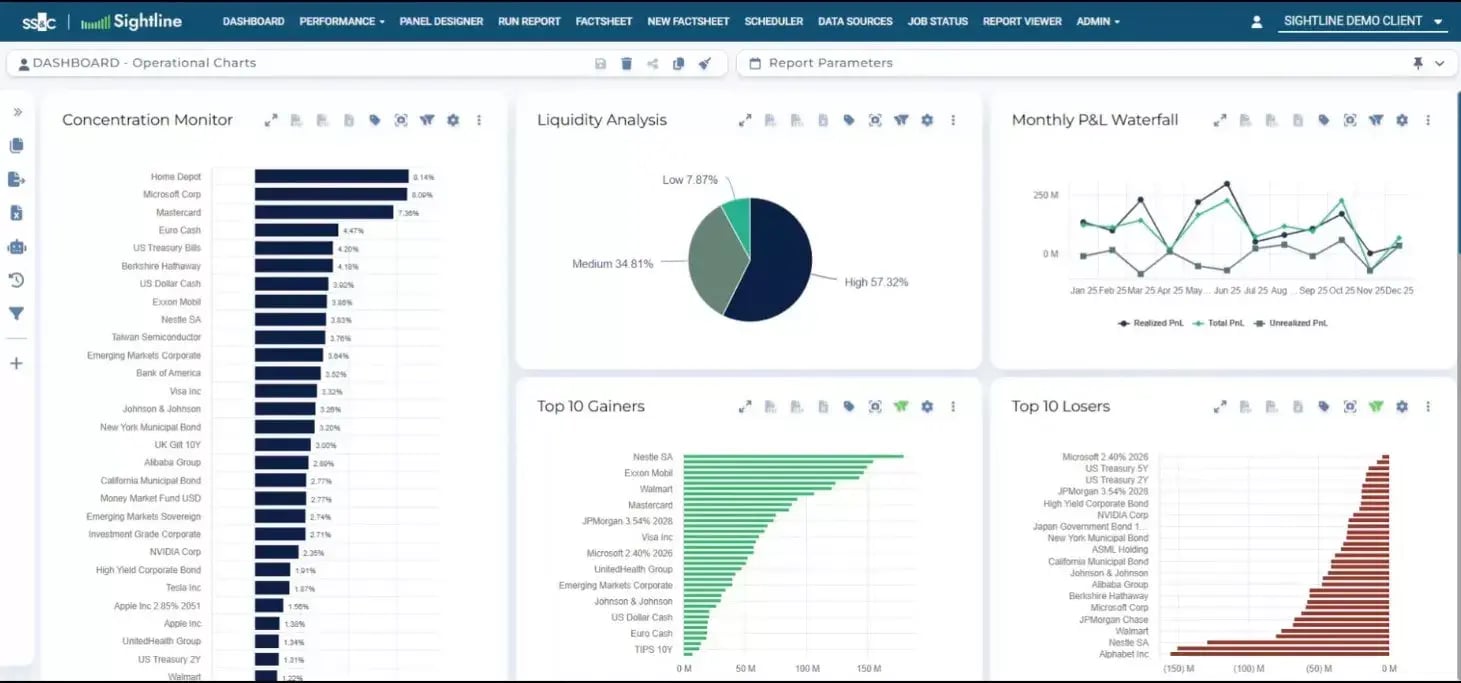
- Dynamic Dashboards and Customization: The interactive dashboards allow business users across a firm to create, modify and export visualizations effortlessly. This functionality was demonstrated with examples such as generating portfolio reports tailored to client needs and fact sheets for different funds.
- Automated Report Distribution: The Scheduler tool automates report delivery, offering flexibility in packaging and delivery methods. Users can pass third-party broker statements directly to Sightline and skip the step of manually attaching them to an email.
- Self-Service Capabilities: Senior managers benefit from immediate data access without dependence on intermediaries. Sightline’s Guidance Agent, an AI-powered assistant, provides real-time help and step-by-step instructions.
- AI-Powered Analytics: The platform’s Data Analyst Agent offers quick answers to analytical queries using conversational language.
Strategic Adoption
One of the more practical themes throughout the discussion was the importance of phased implementation. Rather than attempting a wholesale technology transformation, organizations can achieve faster results by focusing first on the reporting processes that create the greatest operational burden. In practice, this means that rather than migrating everything in one go, organizations can start with the most broken reports and move forward gradually.
This phased approach not only mitigates risks but also builds confidence as firms see immediate improvements in their workflows.
Key Takeaways
- Efficiency and Scalability: Sightline eliminates manual overhead, allowing firms to scale without relying on additional human resources.
- Customization Without Complexity: Firms can offer tailored reporting without falling into a cycle of repeated manual adjustments.
- Self-Service Empowerment: Senior managers can access timely data independently, reducing reliance on reporting teams.
- Flexible Implementation: Sightline integrates seamlessly with existing systems and offers a gradual, non-disruptive adoption model.
- AI Integration: Tools like the Guidance Agent and Data Analyst Agent enhance usability, empowering non-technical users to access and analyze data.
Conclusion
The SS&C Sightline webinar revealed a clear path forward for firms grappling with inefficiencies in reporting processes. Whether solving the “cycle tax” problem, overcoming versioning bottlenecks or empowering stakeholders with real-time analytics, Sightline demonstrates that the gap between clean data and actionable reports can be bridged efficiently, without compromising on flexibility or customization.
For financial institutions seeking transformational change, the insights and solutions offered during the event represent not just a vision but an actionable roadmap.
If you missed the session, watch the "Rethinking Reporting" webinar replay.